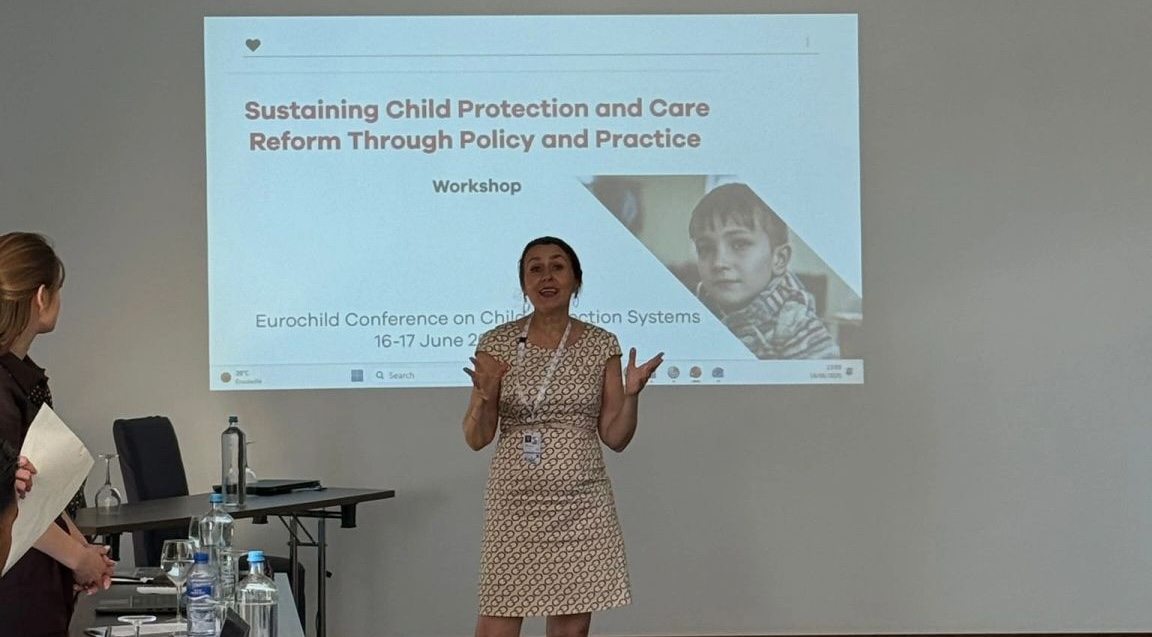
Eurochild Conference on Child Protection Systems, Paphos, 16–17 June 2026
Back in June, I had the pleasure of facilitating the workshop Sustaining Child Protection and Care Reform Through Policy and Practice at the Eurochild Conference on Child Protection Systems. I was joined by three inspiring contributors: Rima Pušić, self-advocate with CCF Moldova; Anouk Moser, Senior Policy and Advocacy Advisor at Lumos; and Altin Hazizaj, Executive Director of CRCA/ECPAT Albania. It was a timely conversation: worldwide, 5.4 million children are locked away in orphanages – even though 80% of them are not orphans – and Europe is no exception.
A Personal Story: Every Child Deserves the Opportunity to Grow Up in a Family
Rima Pušić described her story as one about the power of a family to lay the foundations for a child’s bright future. For almost twenty years, she has been part of a professional foster care family in Moldova – twenty years of growing up, surrounded by people who have given her support, safety, education, confidence and, most importantly, a true sense of belonging.
Her foster family has played an essential role in shaping the person she is today, laying the foundations of her education and the values she carries with her. Thanks to them, she learned the meaning of responsibility, respect, perseverance and self-confidence, and was encouraged to learn, to grow, to discover her abilities and to build her own path in life.
“My experience shows just how much the opportunity to grow up in a family environment can mean to a child,” she said, adding that for her foster care has never been simply a child protection service.
She closed with a heartfelt message: “Every child deserves the opportunity to grow up in a family, and the support we give a child today can help them become an educated, engaged and responsible adult who, in turn, contributes something valuable to society.”
The EU Policy Landscape — and the Money Behind It
Anouk Moser guided participants through the EU framework supporting care reform for children, including the 2026 Social Package, with a special focus on the European Child Guarantee. More than 700,000 children are raised in alternative care in the EU – 40% of them in residential institutions. The extension of the Child Guarantee to EU candidate and potential candidate countries brings a real opportunity to strengthen their reforms.
But policy ambitions are only as strong as the funding behind them. I presented the recommendations of Hope and Homes for Children for the next Multiannual Financial Framework (2028–2034). At their heart is a simple proposition: EU money should actively drive the shift from institutions to families, not sustain the status quo.
That means restoring the funding safeguards that have proven their worth – reintroducing horizontal and thematic enabling conditions in the internal funding regulations, and restoring child poverty earmarking within the National and Regional Partnership Plans (a 5% ESF+ requirement, scaled up to 10% for countries with higher child poverty rates). It means ringfencing a dedicated, transparent tranche for family- and community-based care within both internal instruments – at least 25% of allocations for social inclusion – and external ones. And it means embedding children’s rights across all Regulations, so that the UN CRC and CRPD carry the same weight as rule-of-law conditionality; maintaining Global Europe commitments to Ukraine, accession conditionalities and the SDG framework while explicitly addressing the transition from institutional to family- and community-based care; and implementing the Partnership Principle through inclusive, accessible and transparent participation – including of children and young people with lived experience.
A Country Example: Albania
Altin Hazizaj brought these questions down to the ground, with an insight into Albania’s care reform – closely linked to the country’s EU accession process and its commitments on child rights, disability inclusion and poverty reduction.
“Although relevant policies exist, implementation remains incomplete. Sustainable reform requires a decisive shift from institutional care towards prevention, family strengthening, community-based services and quality family-based alternatives, ensuring that no child is separated from their family because of poverty, disability or a lack of local support,” he said.
His recommendations echoed the funding case: EU funding, including IPA III, should support these priorities alongside workforce development, coordination and effective monitoring. Authorities must embed care reform in accession plans, while children, young people, civil society and EU actors contribute evidence, oversight and advocacy to sustain progress across political cycles.
Where Advocates Can Act
Building on Albania’s example, I offered a quick overview of the EU enlargement process and the advocacy openings it creates: the European Commission’s annual Enlargement Reports, the implementation of the European Child Guarantee, and the EU Human Rights Dialogues. To help civil society make the most of these, Anouk and I presented the draft toolkit for civil society organisations Reforming child protection and care in EU accession, prepared jointly by Hope and Homes for Children and Lumos, which will equip NGOs in EU candidate and potential candidate countries with an overview of all the EU policies and legislation they can use to advance care reform.
What We Heard From the Room
Participants then worked in three groups on how to apply all of this in their own countries. Three themes stood out.
Shared Challenges Across Countries
First, the challenges are strikingly shared. From Germany to Bulgaria, participants described the same obstacles: workforce shortages, the low prestige and undervaluation of social work, and the continued existence of institutions in every country.
Diverging Trajectories — and Why Narratives Matter
Second, trajectories diverge and narratives matter. Bulgaria was highlighted as a positive example of progress, with a favourable public perception of foster care. Ukraine offers a stark contrast: in 2022 there were 700 institutions, a number that has remained essentially unchanged, with approximately 23,000 children still accommodated in them (data shared by the Ukrainian participant). Negative media narratives – framing reform as the government taking children from their homes – present a significant obstacle. Scotland, meanwhile, showed what can drive change: with relatively little institutional care, the UN Committee on the Rights of the Child’s Concluding Observations have been instrumental in securing legislative reform, supported by good access to parliamentarians and government.
Reform Cannot Be Imposed — It Must Be Built
Third, reform cannot be imposed – it must be built. Across Bulgaria, Cyprus, the UK, Estonia and Ukraine, a clear consensus emerged: change must come through inclusive, participatory processes, not top-down decree. The Bulgarian experience illustrates the risk of proceeding without sufficient societal agreement. And any reform must be child-centred with the child at the heart of all systems, and those systems coherent, joined-up and organised around the child’s needs.
The Thread That Ties It Together
That final consensus is, for me, the lasting lesson of the workshop. Whether the lever is an EU funding regulation, an accession benchmark or a UN Committee recommendation, reform only endures when it is built with children and families, not merely for them and when every system, in every country, is organised around one goal: bringing children Back to Family.
